Dye Sublimation Printing on Mugs
How Dye Sublimation Mug Printing Works
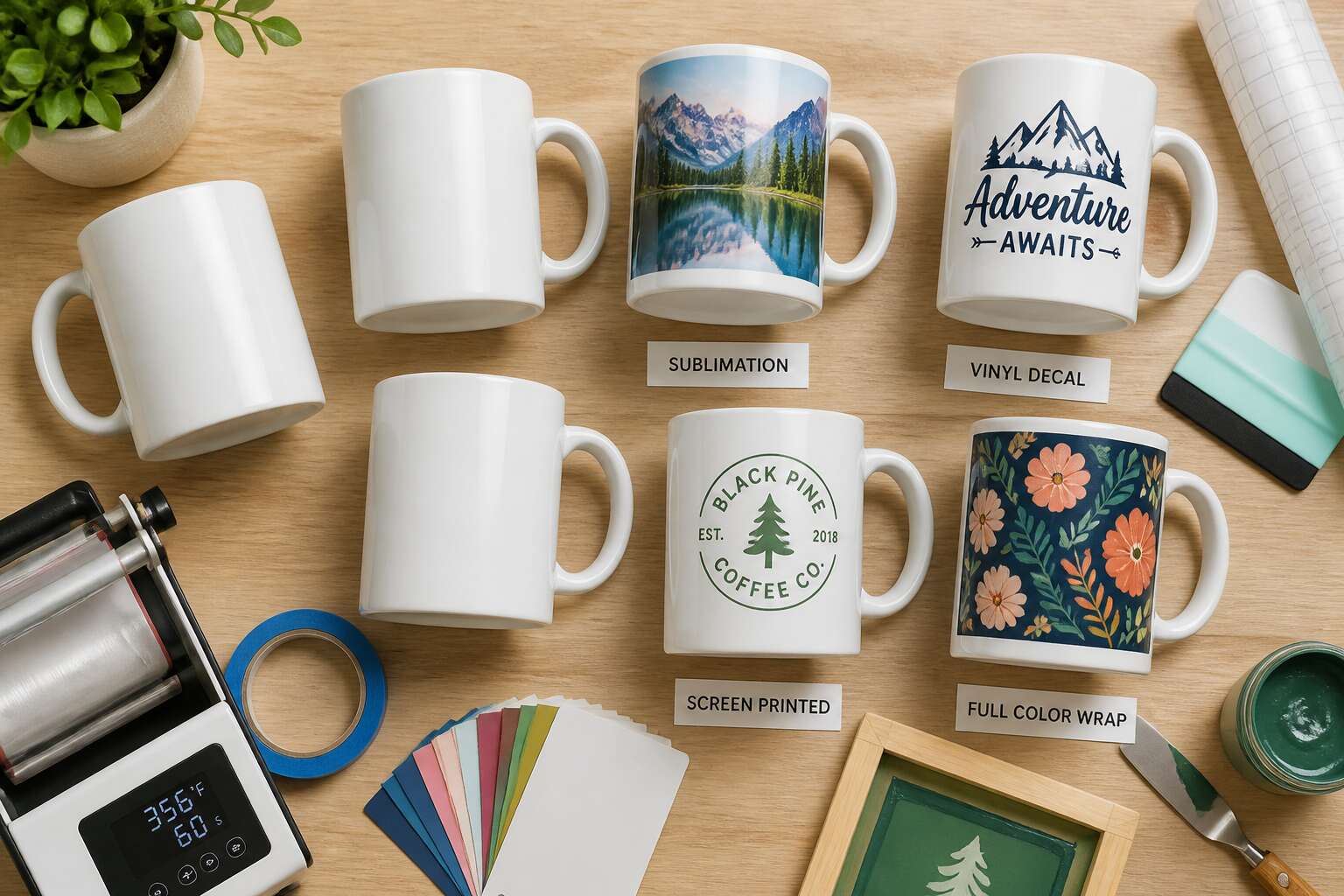
Among the many mug printing types, dye sublimation remains a preferred choice for its permanence. The process begins with a printed transfer sheet, laden with special dyes, pressed against a polymer-coated mug. At roughly 200 degrees Celsius, the dye turns to gas and bonds with the coating at a molecular level. The image becomes part of the mug itself.
For South African businesses seeking full-colour logos or intricate artwork, this method delivers exceptional vibrancy. The continuous tone reproduction creates gradients and photographs with a smoothness that pad printing or vinyl never achieves.
The workflow is straightforward:
- Print your design onto transfer paper using sublimation inks.
- Wrap the paper tightly around the mug and secure it with heat-resistant tape.
- Place the mug in a heat press for 60 to 90 seconds.
After cooling, the paper is peeled away, revealing a print that resists dishwashers and sunlight.
Essential Equipment for Sublimation
A sublimation mug is only as vivid as the machines that birth it. When comparing mug printing types, the equipment alone can shift results from faded to flawless. The essential toolkit begins with a printer outfitted for sublimation inks, an Epson EcoTank or Sawgrass model. Standard inkjet printers fail here; the dyes require a specific particle dispersion to vaporize cleanly.
Then, transfer paper. High-release paper ensures that every gram of dye leaves the sheet and enters the polymer coating. Heat-resistant tape secures the wrap, and a clamshell heat press delivers the 200 degrees Celsius needed for the molecular bond.
You will also need:
– A mug press attachment or a flat press with a mug adapter
– Protective gloves for handling hot blanks
– A lint-free cloth to wipe the mug before pressing
In my experience, this arsenal separates amateur experiments from professional output. It determines what South African businesses expect from mug printing types.
Ideal Mug Materials for Dye Sublimation
Here is a truth that surprises many South African clients: the mug itself matters more than the machine. Dye sublimation only bonds with polymer coated surfaces. A standard ceramic mug from the local shop will simply wash your design down the drain with the first rinse.
Ideal mugs feature a polyester coating fused onto the ceramic at high temperatures. This coating acts as a receptor for the dye gas, allowing the image to become part of the product rather than sitting on top of it. For mug printing types, this makes the blank the true hero of the process.
- White glossy ceramic with polymer coating for maximum vibrancy
- Matte coated mugs for a softer, premium finish
- Colour changing mugs with a polyester layer that reacts to heat
Each mug printing type requires a certain coating density. Too thin, and your logo fades after three washes. Too thick, and the colours bleed like uncapped permanent marker.
Strengths and Weaknesses of Sublimation
Fewer than half of locally sold mugs with printed designs survive a year of daily use. The fault lies almost always with the blank, not the artwork. Sublimation printing on mugs rewards those who respect this fact, and I have watched the process reward patience with brilliance. The strengths are genuine. Colours infuse past the surface, producing an image that survives dishwashers and the Highveld sun. The design becomes part of the ceramic itself, permanent and vibrant.
Weaknesses exist, however:
- Sublimation refuses to work on dark backgrounds.
- White or light coated mugs are mandatory.
- Temperature variations create ghosting or faded patches.
For mug printing types, sublimation remains the leading method for full colour, wrap around branding despite these limits.
UV Printing Methods for Mugs
Understanding UV Flatbed Mug Printing
A mug’s curve can make or break a direct print. UV flatbed technology handles that curve by printing straight onto the surface with liquid inks. Each layer is cured by ultraviolet light, locking in colour immediately. The result is a durable, raised texture you can feel with your fingertips. For South African businesses, this method suits short-run orders and prototypes where speed matters more than volume.
I prefer direct UV printing for several reasons:
- No transfer paper or tape to deal with
- Opaque whites and metallic inks work on dark mugs
- Scratch resistant finish after curing
- Quick setup for individual designs
The catch is the coating. Ceramic and glass need a UV receptive primer, so you can’t just run any mug through the machine. But when you consider all options, UV flatbed remains one of the more flexible mug printing types for custom work.
Design Flexibility and Color Capabilities
Design freedom is the real advantage. UV inks cure instantly, so you stack layers of colour without waiting between passes. That matters when your artwork includes fine details or gradients that would muddy on other mug printing types.
The colour gamut is striking. Photorealistic reproduction is standard, with spot colours matched to brand guidelines. White ink sits beneath the image to keep it vivid on dark ceramics, and metallic finishes add a tactile opulence.
Variable data printing lets each mug in a short run carry a different name or number. For personalised corporate gifts and bespoke retail lines, that capability is transformative. South African studios use it for wedding favours and heritage-branded merchandise alike.
Texture, Relief, and Special Effects
The ridge, the depth, the abrupt rise of a printed edge: these tactile quirks are often missed in conversations about mug printing types. UV printing, however, builds physical structure directly onto ceramic surfaces. Ink accumulates in repeated passes, forming a tangible relief that stands above the base glaze. A logo becomes a raised monogram, readable by fingertip before the eye registers colour.
The practical range of effects is worth cataloguing, and I keep returning to a few favourites:
- Raised spot varnish for tactile brand marks
- Glitter-infused inks that catch afternoon light
- Soft-touch matte finishes that resist fingerprints
- Braille-style bumps for accessibility
Each effect layers onto the same print pass, keeping production costs modest. A studio in Johannesburg now experiments with topographic textures on heritage mugs, turning a simple drinking vessel into a conversation piece. For corporate gifts, sensory detail elevates the object from disposable to treasured.
Durability and Weather Resistance
A raised texture means nothing if it washes away after a month. UV cured ink forms a cross linked polymer that bonds to ceramic at a molecular level. It survives dishwasher thermal shock and UV degradation from direct sunlight. In South Africa’s coastal air, salt and humidity attack lesser print methods. UV printing holds!
I have watched mugs survive daily punishment. Field testing reveals the following:
- The ink tolerates temperatures up to 80 degrees Celsius without softening.
- Marginal fading appears only after 500 industrial dishwasher cycles.
- Outdoor exposure for six months shows no measurable colour shift.
- Adhesion remains intact through freeze thaw cycles.
These numbers define the durability gap between mug printing types. The ones that impress in a showroom often fail in real conditions. UV printing delivers permanence, turning a promotional item into a daily companion. Durability is not glamorous. It is the quiet promise that the mug remains unchanged tomorrow.
Best Use Cases for UV Printed Mugs
Walk into any Durban boardroom and you will see shelves of identical mugs that nobody touches. UV printed mugs break that pattern. Their raised texture invites the hand, which is why they suit premium client gifts, staff awards, and tourist souvenirs across South Africa.
Consider where the mug will live:
– Boardroom shelves, where a glossy finish signals status.
– Coastal holiday homes, where salt air tests every surface.
– Retail displays, where shoppers pause to feel the print.
That tactile pause translates to perceived value. When comparing mug printing types, UV printing delivers a physical story that flat decoration cannot match.
Screen Printing and Pad Printing
Traditional Screen Printing for Curved Surfaces
Screen printing on curved surfaces feels like a craft passed down through generations. The process uses a squeegee to force ink through a mesh screen, but for mugs, the screen must flex or the mug must rotate. This method suits simple designs and bold colors.
Pad printing takes a different route. A silicone pad lifts ink from a cliché plate and presses it onto the mug. It handles fine details and irregular shapes well. When weighing mug printing types, these two methods remain mainstays for promotional items.
Here are common uses:
- Simple logos and text
- Single color or limited color designs
- High volume orders
Both techniques offer durability, though screen printing still produces thicker ink layers for a lasting grip.
Pad Printing Explained
Pad printing goes where screen printing cannot always follow. A silicone pad lifts ink from a cliché plate and presses it onto the mug with remarkable accuracy. This makes it a serious contender among mug printing types for intricate artwork and uneven contours.
What sets pad printing apart is its ability to handle irregular surfaces without distortion. You can print over seams, handle bases, or textured glazes while keeping fine lines crisp. In my experience, it is the preferred method for detailed logos and multi color work that screen printing handles poorly.
- Fine typography and sharp edges stay clean
- Color registration remains accurate across runs
- Smaller quantities become more practical
The tradeoff is a thinner ink deposit than screen printing. That places greater importance on ink formulation and curing for long term durability. For most promotional mugs, pad printing offers the best balance of detail and cost!
Cost Considerations and Production Volume
The true division between these mug printing types emerges when you tally the ledger. Screen printing demands substantial setup capital. Each colour requires a dedicated screen, a registration jig, and a drying rack. That investment only dissolves when your order stretches into the thousands.
Pad printing requires less upfront spending. Cliché plates cost a fraction of screen mesh, and alignment takes minutes, not hours. The unit price sits higher, but the breakeven point arrives far sooner. In my experience with Cape Town clients, a run of three hundred branded mugs favours pad printing every time. Among all mug printing types, pad offers the gentlest entry curve!
- Screen printing setup costs escalate with each additional colour
- Pad printing clichés remain economical for short runs
- Screen printing unit costs plummet at high volume
Production volume ultimately dictates the wiser choice. Below five hundred pieces, pad printing prevails. Above two thousand, screen printing dominates on cost per unit.
Heat Transfer and Digital Mug Printing Options
Heat Transfer Vinyl (HTV) Mug Decoration
Scan the shelves of any South African market stall and you will spot a new array of mug printing types. Heat transfer vinyl, or HTV, is the method behind many of them. Unlike sublimation, which dyes the coating, HTV sits on the surface. I have stood beside crafters in Durban who press a vinyl design onto a ceramic mug and hand it to a customer within two minutes. The speed still surprises me!
The finished surface feels slightly raised. That tactile quality suits logos, names, and bold shapes. For this method, the materials matter as much as the press itself:
- coated ceramic mugs for crisp edges
- enamel camping cups for rugged use
- glass despite its slippery surface
Each substrate changes how the vinyl grips. The process demands clean placement and even pressure. A badly aligned vinyl layer ruins the piece before it reaches the customer’s hands.
Direct-to-Film (DTF) Transfer Printing
While HTV demands precision cutting, Direct-to-Film (DTF) transfer printing prints your artwork onto a film, dusts it with adhesive powder, and presses it onto the mug. The result handles gradients, photographs, and tiny text without the fuss of layered vinyl.
DTF stands apart from other mug printing types because the transfer leaves a rubbery texture that matches the detail of sublimation on coated surfaces. South African creators producing souvenir mugs with Table Mountain sunsets or township scenes in full colour will find DTF a viable option.
The process does have quirks:
- The film needs a pre-press to activate the adhesive
- Cure time matters in humid coastal cities like Durban
- A quality PET film prevents ghosting on curved surfaces
Deep curves cause the film to wrinkle, so stick to straight-walled mugs. I learned that after a batch of creased failures. That separates DTF from mug printing types that handle rounded profiles.
Direct Inkjet Printing on Coated Mugs
Heat transfer paper remains a dependable entry point among mug printing types. You print onto a coated sheet, press it onto the mug, and peel the carrier away. It delivers crisp solid colors and simple logos, though it struggles with photographic gradients and fine text.
Direct inkjet printing on coated mugs removes the intermediate step. The printer sprays ink directly onto a polymer coating, followed by a clear overprint to seal the image. This method prints white ink without a separate underbase, which means dark mugs finally get full-colour designs.
- Heat transfer paper works well for low-volume, budget-conscious orders
- Direct inkjet handles high-detail reproduction on coated surfaces
- Neither option survives heavy dishwashing, so warn your customers
South African decorators choosing between mug printing types should weigh these two against their production volume. I have seen both fail spectacularly in a commercial dishwasher, so set expectations early. Both suit small batches and quick turnarounds, but neither matches sublimation’s durability on a daily-use mug.
White Toner Printing for Dark Mugs
White toner printing takes a different path to dark mugs. A laser printer lays down CMYK colours with a white toner layer beneath them onto a coated transfer sheet. That sheet is heat pressed onto the mug, and both layers fuse into the surface. Dark ceramics finally show full colour without a separate underbase. Among mug printing types, this one balances digital convenience with physical durability.
The process suits South African decorators who need moderate output and sharp detail. It demands a close eye on pressure and heat, because the transfer sits on a thin polymer film that must bond evenly. In my own workshop the first few attempts came out patchy until I adjusted the press timer.
- Fine text and small logos
- Photographic prints on dark backgrounds
- Small batch custom orders
Comparing Quality Across Digital Methods
Quality across digital mug printing types depends on where the ink settles and how it bonds. Heat transfer methods vary in resolution, colour gamut, and hand feel, so the choice changes the final product.
I have tested samples side by side, and the differences show up in subtle places. Halftone dots on a budget transfer look fine from a metre away, but up close they muddle. A properly calibrated digital press holds crisp edges on fine text. Durability also shifts. Some films peel after a few dishwasher cycles, while others fuse so completely that the mug breaks before the print does.
For a decorator weighing options, these factors matter:
- Colour accuracy under warm shop lighting
- Resistance to abrasion on textured ceramics
- Consistency across a full production run
South African conditions add a wrinkle. Humidity and load shedding alter press temperatures, so the same settings do not always produce the same result. I keep a log of every run now, because what worked in July may fail in January.
Choosing the Right Heat Transfer Technique
Choosing the right heat transfer technique for a mug order is a balancing act. Some mug printing types rely on pressure and time, while others demand precise temperature curves. In South Africa, load shedding complicates this further, because a sudden power drop mid-cycle can alter the bond between ink and ceramic. I have seen transfers that looked flawless when applied at 180 degrees fail at 175.
Consider the surface texture. A glossy mug responds differently to a matte one, and thick rims shift how the heat blanket wraps. The mug printing types you choose should match the shape as much as the artwork.
- Polymer-coated blanks for smoother ink absorption
- Uncoated ceramics for a natural, tactile finish
- Wrap time versus dwell time adjustments
A consistent press and careful logging matter more than any single technique.
Selecting the Ideal Mug Printing Type
Production Volume and Turnaround Time
Every mug printing order carries two hidden specifications: the quantity and the clock. Ignore either one and the project stalls before the first print. Digital methods like dye sublimation reward larger runs, since setup stays minimal while per-unit cost drops as volume climbs. For a handful of commissioned pieces, though, the same method becomes wasteful.
- Under 50 units, transfer-based methods offer the fastest turnaround.
- Between 50 and 500 units, dye sublimation balances speed and cost.
- Above 500 units, screen printing becomes the economic frontrunner.
UV flatbed printing sits in the middle. It handles short runs competently, though each pass demands careful registration. Turnaround time also depends on curing. Inkjet and toner systems need no post-cure, while sublimation requires controlled heat and dwell time. In my experience, a reliable supplier should provide realistic schedules based on the specific mug printing types they operate.
Full-Color Detail vs. Simple Graphics
Load a mug design with 40 gradient layers and you will separate the competents from the pretenders among mug printing types. Simple graphics, a logo and a phone number, pass with little effort. That is the real selection test.
Sublimation handles continuous tones. UV flatbed printing also manages complex colour, though it favours designs with smaller ink coverage. Screen printing, reliable for single colour runs, struggles with photographic detail unless you pay for halftones.
For a quick visual guide:
- Photo gradients and subtle shading: choose sublimation or UV flatbed
- Flat vector art and bold text: screen printing or pad printing will suffice
- Intricate multi colour patterns: your choice narrows with each added colour
A design with fine lines and tiny lettering will punish imprecise registration. The correct choice among mug printing types depends on how much detail your artwork demands.
Upfront Investment and Per-Unit Costs
Upfront investment separates the serious operator from the casual crafter. Dye sublimation demands a heat press, an inkjet printer converted for sublimation inks, and transfer paper. UV flatbed printers require a substantially larger capital outlay. Screen printing setups cost less initially, but they consume valuable floor space.
Consider where the money actually sits:
– Sublimation: consumables rise with every order
– UV flatbed: the machine purchase dominates
– Screen printing: labour and setup time
Per-unit costs tell a different story. Sublimation consumables accumulate with each sheet. UV ink is expensive per millilitre. Screen printing spreads its costs across volume. The choice among mug printing types therefore hinges on your expected order sizes. A short run favours digital methods. A thousand identical mugs favour traditional approaches. Your budget structure, not the retail price, determines which method is viable.
Durability and Dishwasher Safety
Durability separates mug printing types that survive years of use from those that fade within months. The dishwasher is an unforgiving judge, exposing every weakness in the print layer. Heat alone is enough to soften many inks!
Dye sublimation resists because the dye penetrates the polymer coating rather than resting on the surface. UV flatbed prints can yellow or delaminate under repeated high heat. Screen printed mugs with ceramic frit inks tolerate machine washing, but plastisol inks break down quickly.
The damage comes from three directions:
- Thermal shock from rapid temperature swings
- Alkaline detergents that soften the ink binder
- Abrasion when mugs shift against each other

0 Comments